
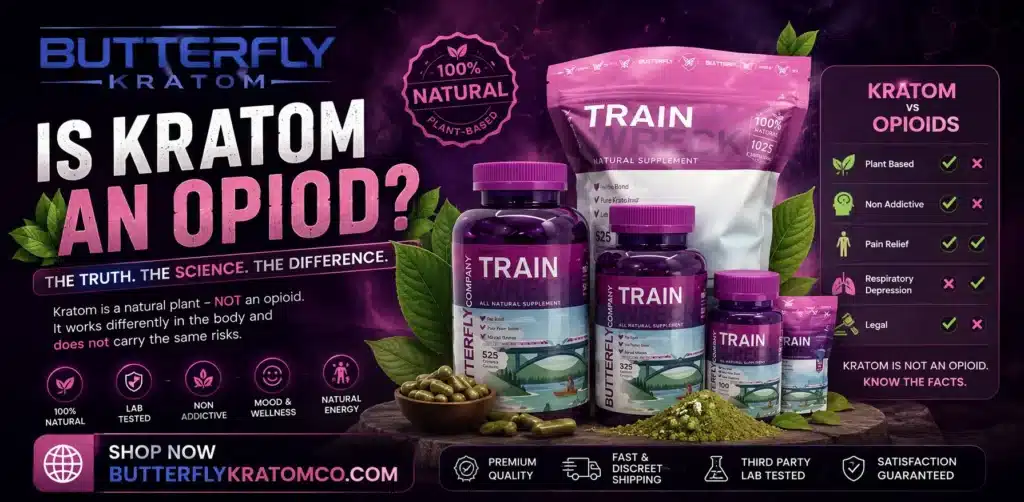
No, kratom is not classified as a traditional opioid, but its two main active compounds – mitragynine and 7-hydroxymitragynine (7-OH) – bind to the same mu-opioid receptors in the brain as drugs like morphine and codeine. This makes kratom “opioid-like” in mechanism, even though it comes from a plant (Mitragyna speciosa) and is not scheduled as a controlled substance at the federal level in the U.S. as of 2026. Because of this overlapping action, kratom can produce pain relief, mild euphoria, and – with heavy or prolonged use – dependence and withdrawal symptoms similar to opioids.
What is Kratom?
Kratom is the common name for Mitragyna speciosa, a tropical evergreen tree native to Southeast Asia, particularly Thailand, Indonesia, and Malaysia. For centuries, local communities chewed the raw leaves or brewed them into tea for energy, pain relief, and as a folk remedy during manual labor.
Today, kratom is sold in the U.S. and globally as a leaf powder, capsule, extract, or shot, marketed mostly through smoke shops, vape stores, and specialty online retailers. It’s important to note upfront: kratom is not FDA-approved as a drug, supplement, or food additive, and no medical claims should be attached to it. Its popularity has grown because people describe it as a “natural alternative” for energy, relaxation, or discomfort – but the science behind those effects is exactly what makes the opioid question worth understanding.
Is Kratom an Opioid? The Pharmacology Explained
This is where nuance matters, and where a lot of online content gets it wrong.
Kratom is not a classical opioid: It doesn’t come from the opium poppy, and its chemical structure is different from morphine, oxycodone, or heroin. Structurally, kratom’s alkaloids belong to a class called indole alkaloids, not opiates.
But kratom does act on opioid receptors: Research published in the Journal of the American Chemical Society and later work summarized by Scientific American confirmed that mitragynine and several related alkaloids bind to and partially activate human mu-opioid receptors (MORs) – the same receptors targeted by prescription opioids and heroin. The FDA’s own current position states plainly that kratom’s primary alkaloids bind to the same receptors in the brain as opioid drugs such as codeine.
The key scientific distinction is this: mitragynine and 7-OH act as partial agonists, not full agonists, at the mu-opioid receptor. A full agonist (like morphine) fully activates the receptor, producing strong effects and higher overdose risk. A partial agonist activates the receptor only part way, which researchers believe may translate to milder effects at typical exposure levels – though the risk is not zero, particularly with 7-OH.
The 7-OH Factor
7-hydroxymitragynine (7-OH) deserves its own mention because it’s currently the center of active U.S. regulatory action. Natural kratom leaf contains only trace amounts of 7-OH – less than 2% of total alkaloid content. However, some manufacturers have been selling concentrated or synthetically boosted 7-OH products that behave much more like a potent opioid than natural leaf kratom does. This distinction is exactly why, in July 2026, the DEA issued a formal notice of intent to place concentrated 7-OH products in Schedule I of the Controlled Substances Act – while explicitly leaving natural, unadulterated kratom leaf unscheduled.
Why Mitragynine Isn’t Identical to Morphine
One more mechanistic detail matters for accuracy: studies indicate mitragynine’s activation of the mu-opioid receptor does not strongly recruit a signaling pathway called beta-arrestin-2, which is heavily implicated in classic opioid side effects like severe respiratory depression and rapid tolerance buildup. This is one reason some researchers have studied mitragynine as a template for developing safer pain medications – though this remains an active area of research, not a settled medical conclusion, and it does not mean kratom is risk-free.
Kratom vs. Traditional Opioids: A Side-by-Side Comparison
| Factor | Kratom (Mitragynine) | Traditional Opioids (e.g., Morphine) |
| Source | Plant (Mitragyna speciosa) | Opium poppy or fully synthetic |
| Receptor action | Partial mu-opioid agonist | Full mu-opioid agonist |
| Legal status (federal, 2026) | Not scheduled (natural leaf) | Schedule I–II depending on drug |
| FDA approval | None | Many are FDA-approved medications |
| Standard drug test detection | Not typically detected | Typically detected |
| Dependence/withdrawal risk | Present with regular, heavy use | Present, often more severe |
| Respiratory depression risk | Present, generally described as lower at typical exposure | Well-documented, higher risk |
This table reflects the current scientific and regulatory consensus, not a recommendation to use either category of substance without medical guidance.
Legal Status of Kratom in 2026
Kratom’s legal picture has been shifting quickly, so accuracy here matters:
- Federal level: Kratom leaf itself remains unscheduled under the Controlled Substances Act. The DEA attempted an emergency Schedule I classification in 2016 but withdrew it after significant public opposition.
- 7-OH specifically: On July 1, 2026, the DEA announced its intent to temporarily place concentrated 7-OH and related synthetic derivatives into Schedule I – a process that requires a 30-day public notice period before taking effect. This action targets concentrated/synthetic 7-OH products, not natural whole-leaf kratom.
- State level: Several U.S. states currently ban kratom outright, while many others regulate it through Kratom Consumer Protection Act (KCPA) laws requiring lab testing, age verification (21+), and labeling standards.
- FDA stance: The FDA has never approved kratom for any medical use and maintains that it cannot be lawfully marketed as a dietary supplement, food additive, or drug product.
Because laws vary by state and are actively evolving, always check your local regulations before purchasing.
Common Misconceptions About Kratom and Opioids
Kratom is completely different from opioids:. Not entirely accurate – while it’s not a classical opiate, it does share the same receptor target.
Since kratom is a partial agonist, it’s not addictive: Partial agonists can still cause physical dependence and withdrawal with frequent, heavy use. Lower risk is not the same as no risk.
All kratom products are the same: Natural leaf kratom and concentrated/synthetic 7-OH products behave very differently pharmacologically – this is exactly the distinction regulators are now drawing a legal line around.
Safety Considerations
Kratom is not risk-free, and responsible use starts with being informed:
- Kratom is not evaluated or approved by the FDA for safety or efficacy for any condition.
- Regular, heavy use has been associated with dependence and withdrawal symptoms comparable to mild opioid withdrawal.
- Combining kratom with other substances that affect the central nervous system increases risk and should be avoided.
- People with pre-existing health conditions, or who are pregnant, should consult a healthcare provider before considering kratom.
- If you or someone you know is struggling with dependence on kratom or any substance, speaking with a licensed medical professional is the safest first step.
FAQs
Is kratom classified as an opioid by the DEA or FDA?
No, neither agency classifies natural kratom leaf as an opioid or controlled substance, though both acknowledge it acts on opioid receptors and have taken regulatory steps around concentrated derivatives like 7-OH.
Will kratom show up on an opioid drug test?
Standard opioid drug panels generally do not screen for kratom’s specific alkaloids, so it typically does not trigger a positive result on routine tests unless the test is specifically designed to detect it.
Can kratom help with opioid withdrawal?
Some people report using kratom this way, but it is not an FDA-approved treatment for opioid use disorder, and self-managing withdrawal without medical supervision carries real risks. FDA-approved options like buprenorphine remain the clinically recognized treatment path.
What’s the difference between kratom and 7-OH products?
Natural kratom leaf contains only trace, naturally occurring levels of 7-OH (under 2%). Some manufactured products concentrate or synthesize 7-OH to much higher potency, which behaves far more like a classic opioid – this is the category currently facing DEA scheduling action.
Is kratom legal where I live?
It depends on your state. As of 2026, several U.S. states ban kratom entirely, while many others regulate it under Kratom Consumer Protection Act laws. Always verify your local and state laws before purchasing.
Is kratom safe to use daily?
Regular, high-frequency use raises the risk of building tolerance and dependence, similar in pattern (though generally described as milder) to opioid dependence. Anyone using kratom regularly should stay informed about these risks and consult a healthcare provider with concerns.
Does kratom cause the same overdose risk as opioids?
Because mitragynine acts as a partial rather than full agonist at the opioid receptor, some research suggests lower respiratory depression risk at typical exposure levels compared to full opioid agonists – but risk is not eliminated, especially when kratom is combined with other substances or consumed in concentrated forms.
Conclusion
Kratom sits in a scientific gray area: it isn’t a traditional opioid by origin or classification, but it undeniably interacts with the same opioid receptors that give opioids their effects — and that overlap is exactly why it demands informed, cautious use. The regulatory landscape is actively evolving in 2026, particularly around concentrated 7-OH products, so staying current on both the science and the law matters.
For lab-tested, transparently sourced kratom products and educational resources, visit Butterfly Kratom Co.
Disclaimer: This article is for educational purposes only and is not medical advice. Kratom is not evaluated or approved by the FDA for the treatment, cure, or prevention of any disease. Consult a licensed healthcare provider before using kratom, especially if you are pregnant, nursing, taking medication, or managing a health condition.
About this content: Reviewed against current FDA public statements, peer-reviewed pharmacology research (JACS, Scientific Reports), and 2026 DEA/Congressional regulatory filings for accuracy as of the last updated date above.